
Some things go sideways the moment you do them wrong. Sending generic emails, assuming what someone wants – it is exhausting, and everyone can smell it. Zero-party data collection is what changes all that. The funny thing is, it is the part most brands barely touch, even though it can do wonders for them.
We are fixing that right now. We are going straight into a 7-step zero-party data strategy framework that will help you create a data collection system that actually works because it treats people like humans, not data points.
Table of Contents
What Is Zero-Party Data Collection?
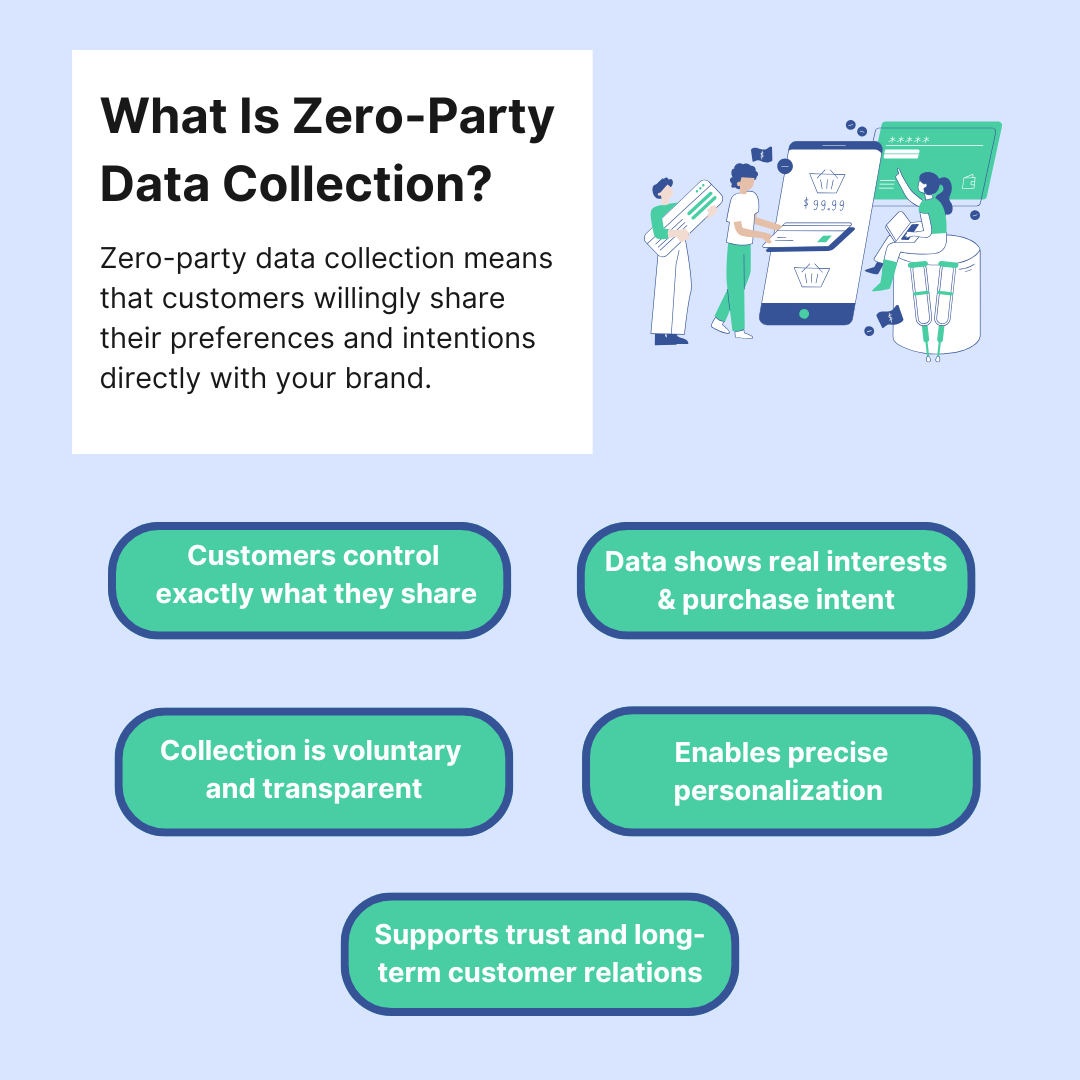
Zero-party data collection means gathering information that customers proactively choose to share with you directly and voluntarily. They give you this data on purpose and with full awareness for a clear benefit in return.
Since the data comes straight from them, it shows their actual purchase intentions, expectations, and interests. This gives brands clean and permission-based insight through an open exchange rather than background tracking.
Here’s how zero-party data differs from other data collection methods:
| Data Type | How It is Collected | Control Level for Customers | Accuracy | Primary Use |
| Zero-Party Data | Customer shares it voluntarily and directly | Very high | Very high | – Personalized Experiences
– Product recommendations – Segmentation |
| First-Party Data | Collected from customer behavior on your own marketing channels | High | High | – Retargeting
– Analytics – Lifecycle marketing |
| Second-Party Data | One company’s first-party data shared with another through a partnership | Medium | Medium-high | – Audience expansion
– Partnership campaigns |
| Third-Party Data | Collected by external aggregators from multiple sites and sources | Low | Low–medium | – Broad targeting
– Lookalike modeling |
| Third-Party Cookie Data | Browser-based tracking across websites | Very low | Low | – Ad targeting
– Attribution modeling |
10 Zero-Party Data Collection Methods
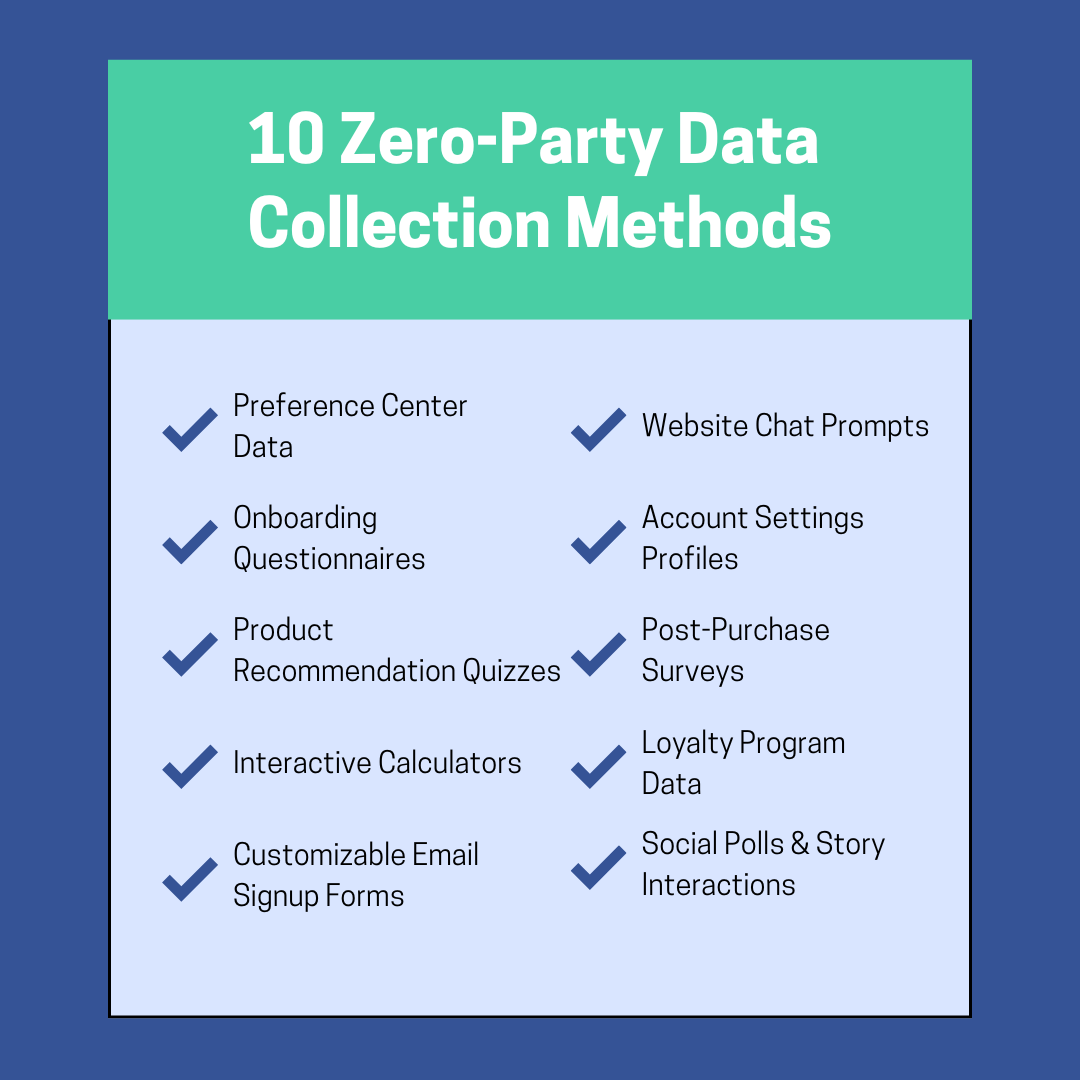
Capturing zero-party data works best when you know exactly how to ask for it. Here are 10 methods that actually get people to share their preferences without forcing anything.
Preference Center Data
A simple dashboard where people pick what they want to hear about. They choose the topics, frequency, and format, and you build your messaging around their choices.
Example: Grammarly has a clean email preferences page where users choose writing tips, product updates, and frequency. Every choice directly decides the type of content they get.
Onboarding Questionnaires
A short set of questions is shown right after sign-up. You learn their needs or challenges before sending anything, so your content matches what they care about.
Example: Duolingo asks about goals (“casual learning,” “daily practice,” “test prep”) to make the content path completely based on the learner’s intent.
Product Recommendation Quizzes
Users answer quick questions and get personalized suggestions. They get value instantly, and you get direct and valuable insight into what they are looking for.
Example: Glossier runs a “Find Your Routine” quiz where people choose their skin concerns. The results give customized product recommendations, and the brand receives direct preference data.
Interactive Calculators
It includes things like budgeting tools, ROI calculators, or size finders. People input real personal details because they want an accurate answer, which gives you high-intent data.
Example: Sewing Parts Online uses a simple machine compatibility checker where users select their machine model, current issue, or preferred accessories. The user gets accurate part matches instantly, while the brand receives high-intent zero-party data based on the exact machine type and sewing tasks the person cares about.
Customizable Email Signup Forms
Instead of just “enter your email,” the form asks what they want more of. A couple of preference fields turn a basic opt-in into a data-rich lead.
Example: Hootsuite asks subscribers to choose content topics like social strategy, platform updates, or case studies. Each pick directly shapes the emails they receive.
Website Chat Prompts
Conversational pop-ups or chatbots that ask friendly and targeted questions. Users respond because it looks natural, and you get clear insight into their interests.
Example: Intercom chat boxes start with short prompts like “What are you trying to do today?” The response drives personalized product tours and reveals user goals.
Account Settings Profiles
When users fill out or update their customer profiles, every field is voluntary. This gives you data that customers intentionally choose to share, like preferences or use cases.
Example: Headspace lets users update their focus areas — stress, better sleep, work performance. Every selection comes directly from the user, not behavior tracking.
Post-Purchase Surveys
This type of survey is a quick “why did you choose this?” after checkout. People answer because they have already committed to the purchase, and their intent is clear.
Example: Allbirds asks customers why they chose a specific shoe – comfort, sustainability, style, or recommendations. Those answers reveal user priorities instantly.
Loyalty Program Data
Members select the rewards or categories they prefer. These choices reveal what they value most without any tracking.
Example: Sephora’s Beauty Insider lets users choose preferred product types and perks, like skincare samples or fragrance rewards. Each preference helps with future recommendations.
Social Polls & Story Interactions
Quick polls on Instagram or LinkedIn. People respond instantly, and the responses show what they prefer in a direct, opt-in way.
Example: Starbucks frequently runs Instagram story polls (“Cold brew or latte today?”). Every tap is direct preference data shared willingly.
Why Is Zero-Party Data Collection Important For Your Business: 5 Key Benefits
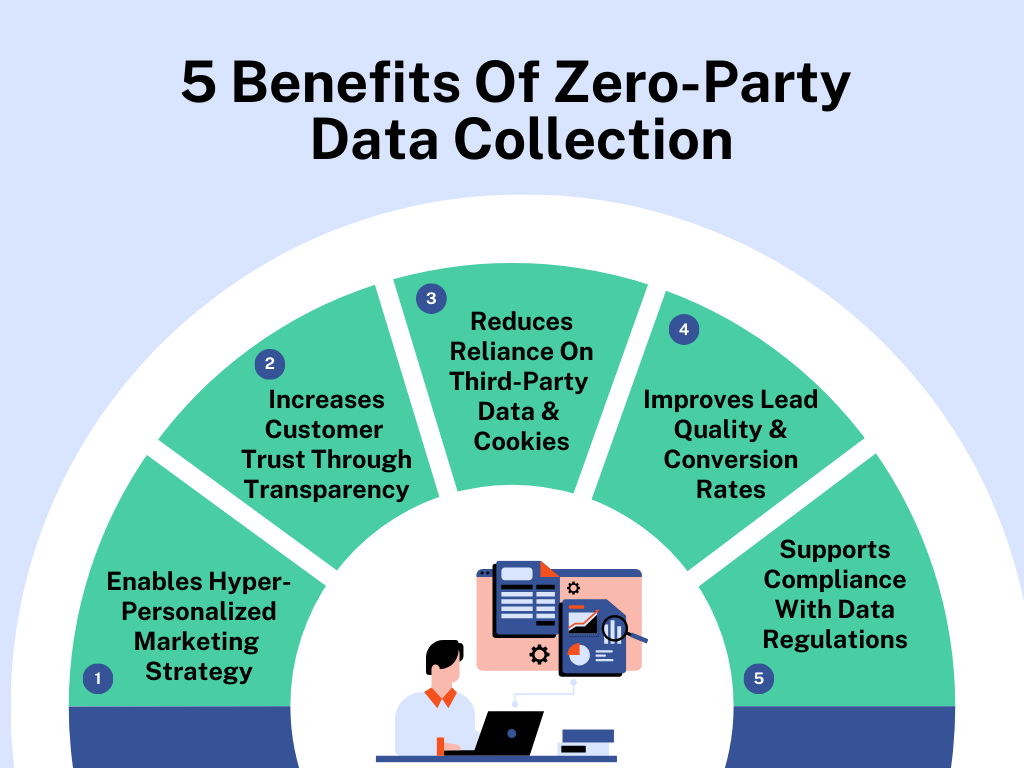
Here are 5 major reasons why collecting and utilizing zero-party data gives you a competitive advantage.
Enables Hyper-Personalized Marketing Strategy
Zero-party data offers the exact details someone wants you to know about them. Not hints. Not signals. Actual customer preferences.
You can leverage zero-party data to create product suggestions that match what someone is actively exploring, and email flows for what they care about today instead of what they searched last month. Your marketing efforts become a one-on-one conversation instead of a broadcast.
Increases Customer Trust Through Transparency
People want to know what you are collecting and why. Zero-party data keeps everything out in the open. You ask. They share. Everything is right on the table. Nothing surprises them later. Building customer relationships becomes easy because they see a brand that respects boundaries and keeps everything upfront rather than scraping information quietly.
Reduces Reliance On Third-Party Data & Cookies
Cookie-based targeting gets weaker every year, and third-party data sources lose accuracy fast. Zero-party customer data removes that dependency. Every insight you gather comes straight from the customer and remains fully under your control. You don’t wait for platforms to change rules or take features away. You build your strategy around information you actually own.
Improves Lead Quality & Conversion Rates
Someone who volunteers information is already warmed up. Zero-party data helps you separate those people from casual visitors instantly. You can see who is just comparing options and who is already close to buying.
This gives you stronger targeting and campaigns that support each stage naturally. Leads convert faster because you are going right to the intent level from the start.
Supports Compliance With Data Privacy Regulations
Consent is built into zero-party consumer data from the first step. The person gives permission at the moment they share the information, so your records stay clean and easy to trace. This lines up with modern privacy rules without complicated workflows or pages of legal interpretation.
You know exactly where data came from and why you collected it, which keeps your business in line with current privacy rules like General Data Protection Regulation (GDPR) and California Consumer Privacy Act (CCPA), and ready for new ones as they roll out.
7 Zero-Party Data Collection Strategies To Capture Conversion-Ready Leads
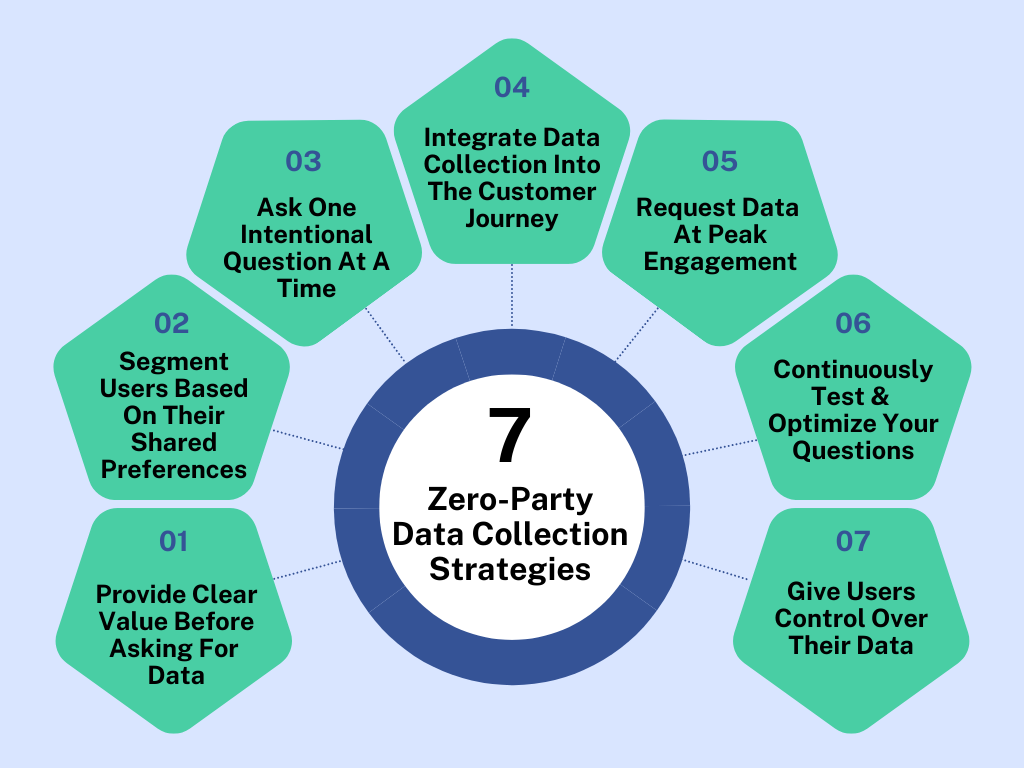
People will give you data if you ask in the right way. These 7 strategies are how you gather zero-party data without annoying anyone.
Always Provide Clear Value Before Asking For Data
You can’t ask for information if the user doesn’t immediately see why it matters. People respond when the trade is obvious. Not vague, not “exclusive access.” Something they can actually use right now. The data request is a mini-negotiation – what they give vs. what they get. Get the value right, and the data comes naturally.
What to Do:
- Offer a micro-solution instead of a generic lead magnet. Example: a calculator that asks about personal tangible assets and gives a tailored estimate or recommendation instantly. Or use a selector that helps users pick the exact product version they need based on their current setup or goals;
- Show the “what you get” list right above the form. Spell out the exact outcome they will walk away with – no broad claims;
- Match the data request to the value. If you give a pricing shortcut, ask only for details about price preferences;
- Remove anything that doesn’t count toward the exchange. If it doesn’t help you personalize or deliver something real, don’t ask for it;
- Make the forms accessible. Use clear labels, large tap targets, readable text, and layouts that work smoothly on every device, so no one drops off;
- Deliver the promised value within seconds. No loyalty points, no email-only access unless absolutely necessary – instant access increases cooperation.
Segment Users Based On Their Shared Preferences
Zero-party data is useless if you don’t act on it. Segment audiences immediately based on what people tell you to turn raw info into actionable paths. Divide by the specifics they share – product interest, priority problem, content type they like – and respond accordingly. Each segment gets exactly what it needs next, not generic marketing messages.
What to Do:
- Create no more than 3–5 segments per data point. Keep segments tight and usable – too many will slow down execution;
- Build dedicated message flows for different customer segments. Even if it is short, let each group get content based on the choice they made;
- Tag every user action immediately. Don’t batch-tag later – mark personal preferences the moment they select them. This works even better when your tags sync directly into your Customer Relationship Management (CRM) software, so every preference instantly shapes your follow-up path;
- Connect each segment to the next logical step. Product-focused users get recommendations. Research-focused users get deep dives;
- Track which segments convert fastest and refine from there. If a segment produces the highest conversion, expand that pathway with more depth.
Ask One Intentional Question At A Time
Every question should have a purpose. One data point, one answer, no overload. Users skip or assume if you ask too much. One focused question at a time gives accurate information and keeps them going. Layer questions across the journey rather than dumping them all at once.
What to Do:
- Identify your top 3 data points needed for personalization. Ask only those – nothing extra at this stage;
- Turn each data point into a single-question interaction. Example: one question per screen, one button per decision;
- Start with the question that directly affects conversions. This could be urgency level, intended use case, or budget direction;
- Connect each answer to a real output. If they choose a use-case, instantly show the solution built around that use-case;
- Space out the remaining questions across the customer journey. Drop them in during onboarding or after a product demo – never all at once.
Incorporate Data Collection Into The Natural Customer Journey
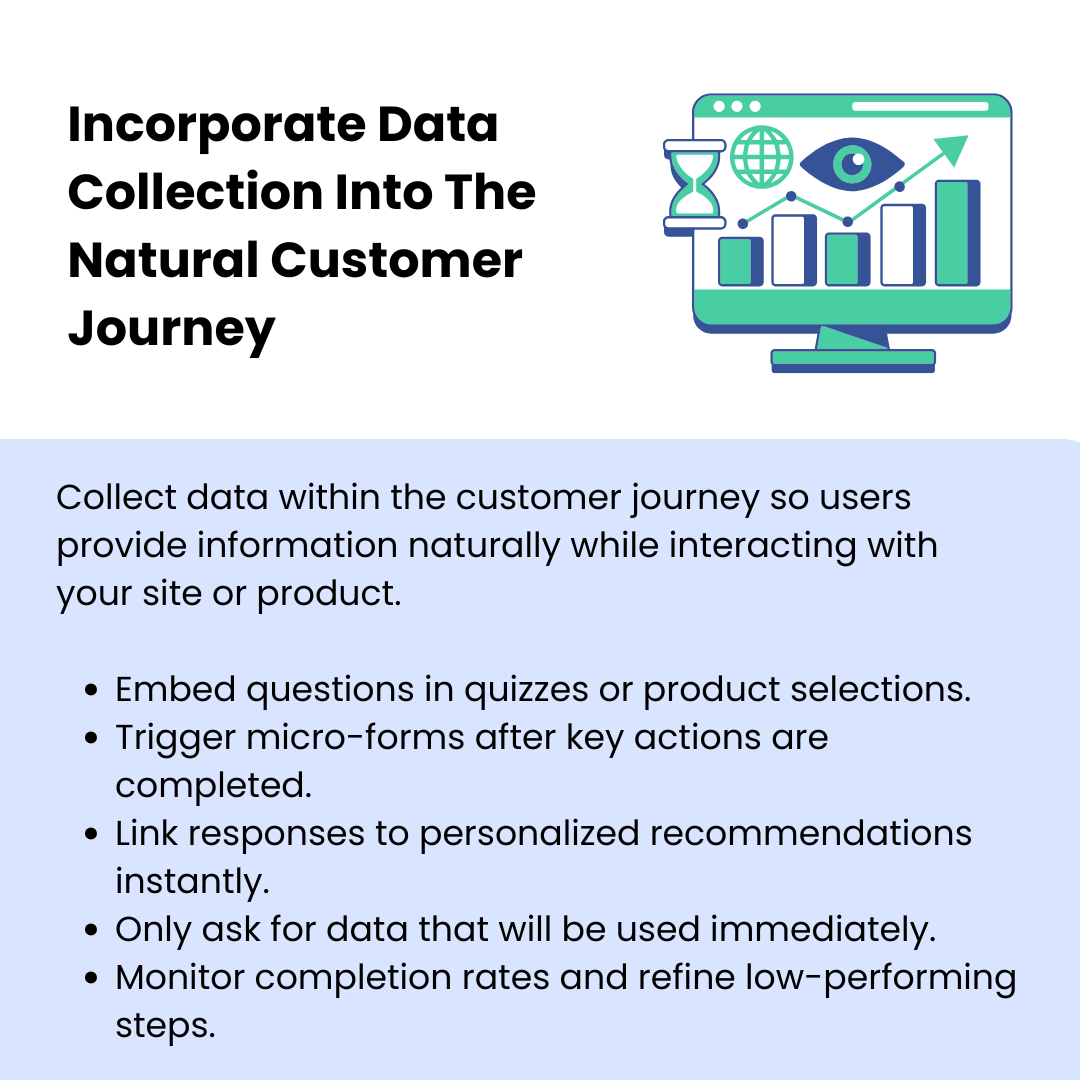
Data collection works best when it is part of what the user is already doing. Don’t interrupt or force it. It should flow naturally with their actions – selecting a product, finishing a quiz, checking out. This way, the user doesn’t see it as an extra task, and you get accurate and intentional input.
What to Do:
- Add preference or intent questions inside quizzes or product selection processes rather than separate forms;
- Use micro-forms that appear only after a major step is completed, like finishing a tutorial or selecting a product variant;
- Automatically connect collected data to the next step – recommend products or personalized offers immediately;
- Remove anything unnecessary – only request the data you will use in the next interaction;
- Track which parts of the flow generate the most completed responses and iterate to make underperforming steps shorter or more intuitive.
Request Data At The Moment Of Maximum Engagement
The closer someone is to taking action, the more likely they are to provide useful information. Timing matters. Ask for data when the user is already invested – like after they interact with a key feature or reach a decision point.
What to Do:
- Trigger questions immediately after a user completes a key action – finishing a quiz, interacting with a product demo, downloading a resource;
- Match the data request with the action they just completed, so it makes sense. For example, after they pick a category of interest, encourage customers to specify preference details within that category;
- Use micro-commitments – short, single questions that are directly relevant to their last action;
- Set up a mass notification software to push short, time-sensitive requests – SMS or voice blasts immediately after a key action can prompt fast responses and capture intent while engagement is still hot;
- Avoid asking for large amounts of data upfront. Break it into small and actionable questions spaced across the journey;
- Track completion rates for different moments and adjust placement to maximize response quality and quantity.
Continuously Test & Optimize Your Questions
Not every question works the first time. Some wordings work, some confuse. Some placements convert, some get skipped. Testing and iterating are the only ways to know what actually does the job. And no, this isn’t just a quick try. You have to constantly improve both the quantity and the quality of identified zero-party data.
What to Do:
- A/B test different wordings for the same question – “Which product do you need?” vs. “Pick your preferred product type.” Measure completion rates;
- Experiment with answer formats – sliders, multiple choice, checkboxes, open-ended fields. Track which type produces more actionable data;
- Move questions to different parts of the flow and compare response quality and quantity;
- Remove questions that consistently have low response rates or don’t influence the next step;
- Review data weekly or biweekly and iterate immediately. Small changes improve data quality in a big way. Use a Customer Data Platform (CDP) to track which questions are delivering high-value responses and store that information centrally;
- When the tests start stacking up, partner with a recruitment firm to bring in a part-time conversion optimization specialist. They can handle structured experimentation and fine-tune your question flow so every answer you collect has a clear purpose and impact.
Respect Privacy By Giving Users Control Over Their Data
Respect is essential. When you put customers above everything else, they will give honest and complete answers. Transparency is the main piece of valuable zero-party data. Users must feel empowered, not trapped. And control should be simple and visible.
What to Do:
- Provide a clear and easy-to-access dashboard where users can edit or delete the data they have shared;
- Explain how each data point will be used immediately at the moment of collection – in simple words;
- Allow selective sharing – let users skip questions without breaking the flow;
- Implement clear consent checkboxes and explain what each checkbox controls;
- Regularly audit your data storage and access policies to make sure they match what you told users. Make it simple for them to manage;
- Add an AI answering service to handle privacy questions on the spot. Many users hesitate because they want reassurance before sharing anything. Rosie can answer those concerns instantly, in plain language, so people feel comfortable moving forward.
Conclusion
Collecting valuable data doesn’t happen by accident. You build it step by step.
So, here’s the final advice – review what you collect, iterate on your approach, and eliminate friction. Remember, zero-party data collection rewards consistency and intention, and it punishes sloppy and generic approaches.
And we at KyLeads can help you do exactly that. We built our platform for people who treat data as a commitment. We give you simple yet powerful tools to collect zero-party data cleanly and with respect. With our popups, quizzes, slide-ins, inline forms, and full-screen takeovers, you can ask exactly one clear question at a time.
Every form you create is fully customizable. You set where it shows, when it shows, and who sees it. That lets you match your asks to personal context instead of spamming everyone at once.
Test it for free today, see how clean and effective zero-party data collection can be.